
India has strongly refuted claims by the United States Trade Representative (USTR) regarding excess capacity in its steel and textile sectors, arguing that the nation's significantly low per capita consumption of these products contradicts such assertions, according to Amitabh Kumar, Additional Secretary in the Ministry of Commerce.

United States President Donald Trump on Saturday threatened to impose tariffs on Denmark and several European countries unless they agree to sell Greenland to the United States, framing the move as a national security imperative amid Chinese and Russian interest in the territory.

India and the US have agreed to a trade deal that will see Washington reduce reciprocal tariffs on Indian goods from 25% to 18%, according to US President Donald Trump. The deal also includes commitments from India to reduce tariffs and non-tariff barriers against the US and to increase purchases of American products.

Tech giant Apple reported a record June quarter revenue of USD 109.4 billion, a 16 per cent year-on-year increase, with significant double-digit growth in emerging markets like India. However, the company anticipates business risks in the coming quarters due to rising memory chip prices and ongoing supply constraints.

'Periods of heightened volatility, driven by global events such as tariffs and geopolitical tensions over the past year-and-a-half, can make some investors pause or discontinue their investments.'

FPIs have already withdrawn Rs 2.6 trillion from Indian equities in 2026, exceeding the outflows recorded in any previous full calendar year.

Donald Trump says several issues were settled during the final day of talks with Xi Jinping covering trade, tariffs, and diplomacy.

United States Senator Lindsey Graham on Sunday claimed that Indian Ambassador to the US Vinay Mohan Kwatra spoke to him last month about India buying less Russian oil and asked him to tell President Donald Trump to relieve the 25 per cent tariff.

Equity benchmark indices Sensex and Nifty experienced a significant decline, primarily driven by a selloff in IT stocks due to concerns about AI disruption and renewed worries over global trade.

US President Donald Trump announced a new global levy on imported items, resulting in a lower tariff rate for India, following a Supreme Court verdict against his previous sweeping tariffs.

Prime Minister Narendra Modi announced that the India-UK Comprehensive Economic and Trade Agreement (CETA) will come into effect on July 15, 2026, anticipating a significant boost to bilateral trade and investment.
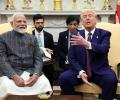
The US Trade Representative has proposed an additional 12.5 per cent duty on goods from 54 countries, including India, citing their failure to prohibit the import of goods produced with forced labour. India has denied the allegations and called for the matter to be resolved through bilateral trade negotiations.
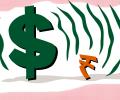
The Indian rupee depreciated by 32 paise to close at 92.83 against the US dollar, influenced by escalating global tensions, particularly the US-Iran conflict, and the deadline for the RBI's instructions to banks to curb overnight positions.

Former US President Donald Trump claimed he stopped a war between India and Pakistan and expressed his desire to be remembered as a great peacemaker.

The Indian stock market's movement this week will be significantly influenced by the outcome of US-Iran talks, global crude oil prices, and the trading activities of foreign institutional investors (FIIs), according to market analysts.

Trump's outburst comes amid escalating tensions between the US and its northern neighbour, following recent remarks by Canadian Prime Minister Mark Carney at the World Economic Forum (WEF) in Davos.
American industry groups sought punitive tariffs on Indian goods at USTR hearings, while Indian officials defended the country's manufacturing growth as demand-led and WTO-compliant.

India and the US are reportedly exploring a potential meeting between Prime Minister Narendra Modi and US President Donald Trump on the sidelines of the G7 summit in France next week, aiming to rebuild bilateral ties after recent tensions.

Foreign Portfolio Investors (FPIs) remained in a selling mode in January, withdrawing nearly Rs 36,000 crore (about $3.97 billion) as global uncertainties persisted. Meanwhile, a higher securities transaction tax (STT) proposed in the Union Budget may weigh on overseas investor participation in the near future.

Canadian Prime Minister Mark Carney on Tuesday warned that the world is witnessing a fundamental 'rupture' in the global order rather than a gradual transition, cautioning against weaponising trade, finance, and supply chains.

In a veiled attack on US President Donald Trump, Canada's Minister of Energy and Natural Resources Tim Hodgson on Tuesday said India's free trade agreement with the European Union is a "perfect" answer to global hegemons that use tariffs and economic integration as tools of coercion.

That means making it easier to invest, protecting investors through predictable rules, and avoiding policy reversals after investments have been made, notes Rajeswari Sengupta.

'The West Asia or the Gulf crisis has shown that what we develop as national infrastructure when things are not as bad as they could be, we forget to plan for adversities.'

From the 30-Sensex firms, Trent, Larsen & Toubro, Reliance Industries, InterGlobe Aviation, Maruti, ITC, Adani Ports and Bharat Electronics were among the biggest laggards. In contrast, Eternal, ICICI Bank, Tech Mahindra, State Bank of India and Tata Consultancy Services were among the gainers.

'This has translated into a combined daily loss of 60 crore in revenues for exporters in Tiruppur, Coimbatore, Erode and Karur districts, pushing many small and medium enterprises to the brink of collapse.'
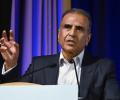
Bharti Airtel is strategically shifting its focus towards data centres, cloud services, and financial services as key drivers for its next phase of growth, leveraging significant past investments in digital infrastructure, as outlined by Chairman Sunil Mittal in the company's Annual Report for 2025-26.

The report notes that equities had faced pressure from elevated valuation premiums, subdued nominal gross domestic product (GDP) and earnings growth, sustained foreign portfolio investor (FPI) selling, artificial intelligence (AI) infrastructure euphoria, and external shocks including US tariffs and a spike in crude oil prices due to geopolitical tensions in West Asia. However, several of these factors are now reversing.

United States President Donald Trump on Monday floated the proposal of imposing 200% tariff on French wine and champagne after French President Emmanuel Macron's reported refusal to sit on the so-called Board of Peace, an initiative created by Trump to mediate global conflict, EuroNews reported.

Prime Minister Narendra Modi and US President Donald Trump exchanged pleasantries and held a brief conversation at the G7 summit, their first in-person encounter in 16 months, setting the stage for high-stakes bilateral talks amidst continuing strain in India-US relations.

'1991 was an exceptional period in Indian history.' 'A big 400-volt shock was administered to the system, which was required. Today, we are in a much, much better position.'

The remarkable rise of smallcaps reflects the emergence of a broad set of specialised businesses operating in industries where the sectoral tailwinds remain considerably stronger than macroeconomic headwinds, points out Debashis Basu.

Indian startup funding plummeted by 43 per cent year-on-year to $7.81 billion between March 1 and June 15, 2026, largely due to the West Asia conflict, which has amplified global risk perceptions, tightened liquidity, and led to rupee depreciation, making global investors cautious.

India's hydropower generation has been significantly constrained in July due to the El Nio effect, which has weakened the southwest monsoon and reduced reservoir levels. This decline, following a 21 per cent year-on-year drop in June 2026, is forcing greater reliance on coal generation and straining grid flexibility amidst rising power demand.

Trump said that the decision would be "immediately" in effect and that the "order is final and conclusive."

Prime Minister Narendra Modi urged US President Donald Trump to prioritise the safety of Indian seafarers in the Strait of Hormuz during the implementation of Washington's proposed Iran peace deal, as both leaders focused on repairing strained bilateral relations at the G7 summit.

European Commission President Ursula von der Leyen says India and the EU are close to a 'historic trade agreement' that could create a market of two billion people and account for almost a quarter of the global GDP.

External Affairs Minister S Jaishankar and US Secretary of State Marco Rubio discussed cooperation in trade, critical minerals, nuclear energy, and defence, reaffirming commitment to a free and open Indo-Pacific.

The BRICS nations have expressed concern over the proliferation of trade-restrictive actions in the form of 'indiscriminate rising' of tariffs, particularly measures used as a means of 'coercion', cautioning that such practices risk marginalising the Global South countries.
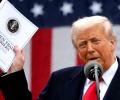
India is closely monitoring developments related to a proposed American legislation that seeks to impose up to 500 per cent tariff on countries procuring Russian crude oil.

India emerged reasonably well from 2025. But now, the oil shock and war-related supply disruptions have again driven funds out of India and significantly weakened the rupee, points out Ajay Chhibber.
